Yesterday was Japan's Marine Day (海の日).
I went to Yokohama with Zack, Wang, and Harry, who's from India.
It was my first time visiting Yokohama.
I have to say, the city left a really good first impression on me.
Both the Minato Mirai skyline and the sea breeze at Enoshima felt genuinely pleasant.
But more than the scenery, what stuck with me were the three very different groups of Japanese people I ran into that day.
Different ages, different personalities, completely different attitudes toward foreigners.
That one day showed me a more three-dimensional, more real version of Japan.
Group One: Young People Whose Warmth Caught Me Off Guard
The first group was two young men, probably around thirty, who looked like Yokohama locals.
We ran into them by chance while waiting at a crosswalk.
They struck up a conversation on their own, casually asking where we were from.
Once they found out we were from China and India, they immediately greeted us in Chinese and English.
Honestly, all of us were a little surprised.
In Japan, strangers striking up conversations out of nowhere isn't exactly common.
We ended up walking together for about three or four hundred meters, chatting the whole way.
It was only a few minutes, but the vibe was relaxed and genuinely fun.
They were talkative, curious about our lives, and kept recommending spots in Yokohama worth checking out.
When we parted ways, they smiled and said:
"Enjoy your time in Japan!"
That's a side of Japanese people I don't get to see very often.
Open, warm, willing to approach strangers first. No sense of distance at all.
It instantly made my first impression of Yokohama even better.
Group Two: The First Time I Felt Genuinely Unwelcome
The second group was a guy in his twenties working at a restaurant on Enoshima.
It was brutally hot that day.
By the time we reached Enoshima, we were already pretty worn out.
None of us were particularly hungry — we just wanted a place with a decent view, somewhere to order a drink, sit down, and rest while looking at the ocean.
So the four of us each ordered a drink.
After we ordered, the male server told us, visibly annoyed, that drink-only orders weren't allowed — everyone had to order food, and each person needed to spend at least 1,000 yen.
Honestly, we had zero issue with the rule itself.
If that's the store's policy, we completely understood, and we were happy to comply.
What actually bothered us came down to three things.
First, there was no visible sign about the minimum spend when we walked in.
Second, nobody mentioned it to us before we ordered.
Third — and this was the real issue — his attitude.
Throughout the whole exchange, he was impatient and sharp-toned, a stark contrast to pretty much every other service experience I'd had in Japan over the past year.
We ended up reordering, food this time, and each of us hit the 1,000 yen minimum.
That should have been the end of it.
But Wang felt the server's attitude was a real problem, so she asked for the manager.
The manager listened carefully to what happened and apologized.
We figured that would settle things.
Except throughout the rest of the meal, the same server kept shooting us unfriendly looks, and never once apologized himself.
At checkout, we explained again — it wasn't the store's rule we minded, it was his attitude.
Unfortunately, he still didn't seem to get it.
What made it worse was something he said partway through:
"Can you speak Japanese?" (日本語を話せますか?)
Since Wang and Harry had mostly been speaking English with him, and it was obvious he understood and could speak English himself, the line landed less like a genuine question and more like a veiled dig.
Then he flat-out told us:
"Get out."
In over a year in Japan, that was the first time I'd run into service that hostile.
To be clear, I don't think this represents Japan, let alone all Japanese people.
But it was a reminder:
no matter what country you're in, you can run into people who let you down.
Group Three: An Elderly Man Standing Against Discrimination
That evening, we went for a walk on Nihon Odori.
Right outside the station, we saw a few elderly people holding signs, running a small street campaign.
One of them, a man who looked to be around seventy, came over and started talking to us on his own.
Their message was simple:
Against discrimination toward foreigners. Against xenophobia.
When he found out we were from China, he showed zero trace of prejudice — instead, he warmly greeted us in Chinese.
Then, smiling, he said:
"Japan and China are neighbors separated only by a narrow strip of water." (一衣帯水の関係です)
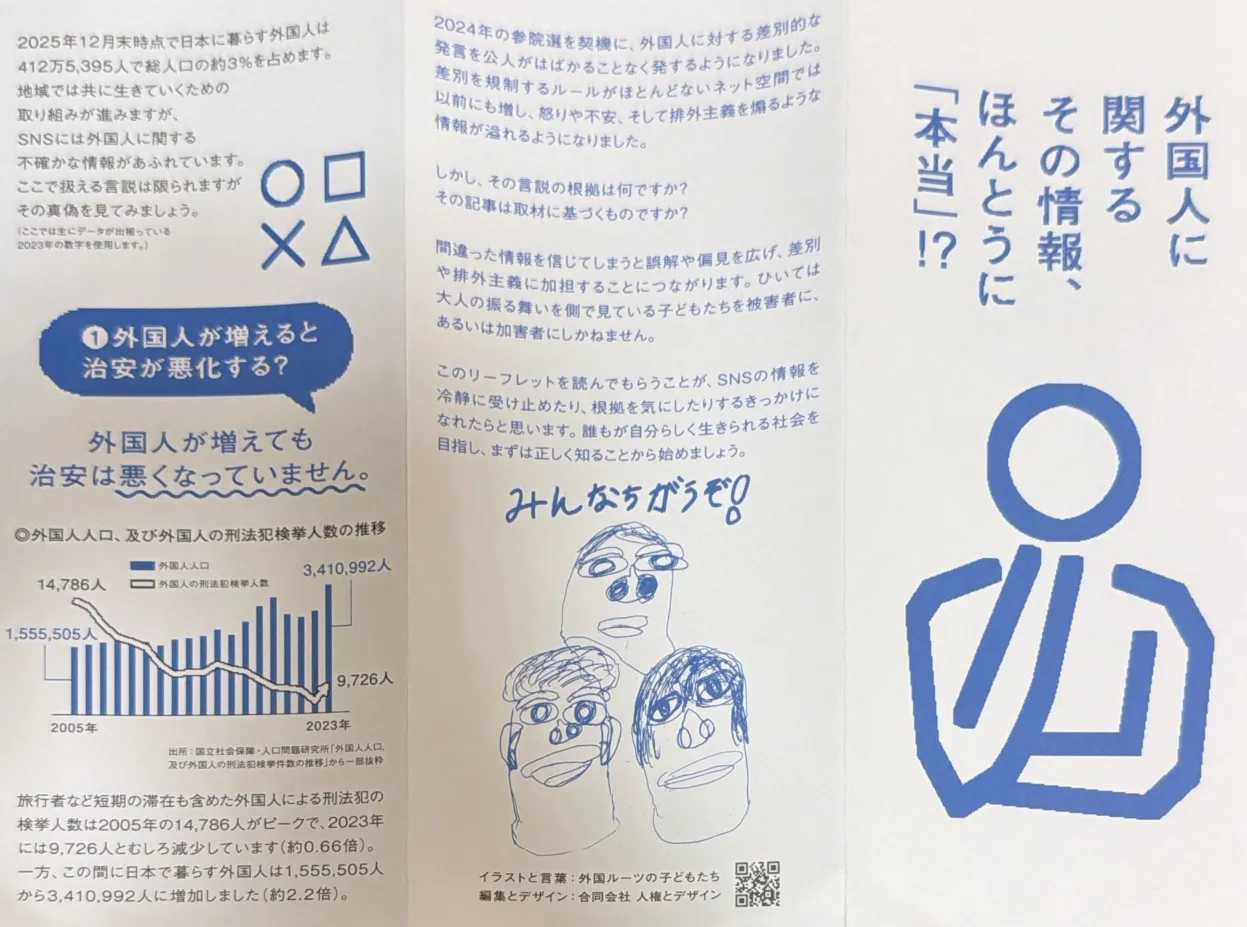
He handed us a pamphlet.
A few lines in it really stuck with me.
More foreigners doesn't automatically mean less public safety.
Before reacting to something on social media, check whether there's actual data behind it.
Don't let isolated incidents shape your view of an entire group of foreigners.
We want to build a society where people can live together regardless of nationality or cultural background.
Reading it, I felt genuinely moved.
Especially having just had an unpleasant experience earlier that day, running into a group like this felt like an odd, fitting coincidence.
One Day, Three Kinds of Japanese People
On the way home, I couldn't stop thinking about it.
All Japanese people.
Some are warm, open, the first to welcome a stranger.
Some are rude, even prejudiced.
And some stand up against discrimination, hoping people from different countries can live together in peace.
The truth is, these three types of people aren't unique to Japan.
China has them.
India has them.
Every country in the world has them.
We're all a bit too quick to slap a label on an entire country or people based on a single experience.
But once you've lived somewhere long enough, you start to realize:
No country is made up of just one kind of person.
One act of kindness doesn't mean an entire country is good.
One act of unkindness doesn't mean an entire country deserves to be written off.
What's actually worth holding onto isn't any single person's behavior — it's keeping your own independent judgment, and not letting one individual define an entire group in your head.
That, maybe, was the biggest takeaway from this Yokohama trip.