I watched a video today by a YouTuber who covers politics and economics — Teacher Sun. The gist of the title was something like: Japan's economic struggles are rippling across Asia, demographic shifts are creating three converging crises, and why do Asian countries keep falling into a "late-developer's curse"?
One idea in the video stuck with me: some Asian countries, racing to catch up with the West, achieved rapid economic growth through fast urbanization, industrialization, and modernization — but buried inside that breakneck growth were costs that were nearly invisible at the time. One of them was the shift in demographic structure and the falling birth rate.
Of course, there's plenty to debate here. Aging populations can't be reduced to a single cause like "learning from the West and urbanizing." Economic development, education, housing costs, women's workforce participation, changing attitudes toward marriage and children, and social safety nets all interact to shape birth rates.
But what really caught my attention wasn't the argument itself — it was that it dragged back up something I'd vaguely understood years ago:
Whatever you gain, you also lose something.
Most of the time, when we're in the middle of gaining something, we have no idea what we're quietly losing.
And sometimes it takes years before we even realize what that loss was.
I. Even economic development can hide a price tag
When a country is economically behind, what's the single most important goal?
Development, obviously.
Build the cities, lay the highways, grow the industries, boost productivity, pull more people into urban centers, give more people a better life.
None of that is wrong in itself.
The problem is: every model of development comes with side effects.
When a country moves fast from an agrarian society into an industrial one, huge numbers of people leave the countryside for cities, education levels rise, women enter the workforce in greater numbers, and young people start chasing a better lifestyle. Naturally, marriage and childbearing get pushed later, and the desire to have children often drops.
But at the time, what people mostly see is the upside right in front of them:
The cities keep getting more beautiful.
Wages keep climbing.
Life keeps getting more convenient.
Per-capita income keeps rising.
Almost no one stops to think:
Decades from now, could these very changes end up reshaping the population structure of the whole society?
Which raises a question I find genuinely interesting:
Could what we call "progress" today also be the starting point of some future problem?
This isn't an argument that development is wrong.
It's more that:
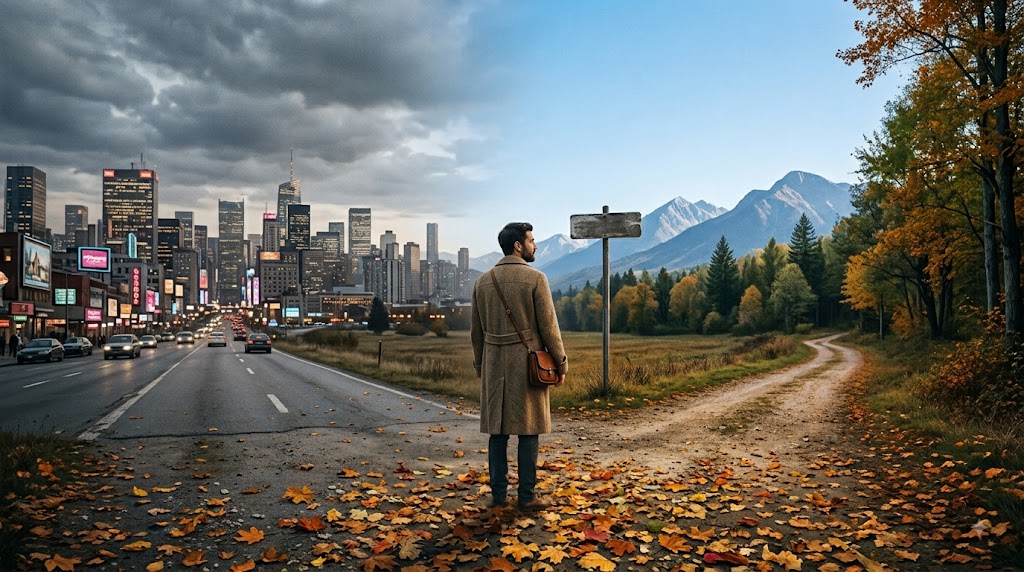
Every choice has an opportunity cost. Every gain can come bundled with some form of loss.
It's just that some prices get paid immediately, and others don't show up for decades.
II. I first truly understood "you have to let go to gain" — after going viral
Actually, I'd already sensed this, vaguely, years earlier.
Back then, I used to edit film and TV clips for Douyin (China's TikTok).
At first, it never occurred to me to make money off it.
It was pure interest. I'd watch a movie or a show I liked, cut together the scenes that moved me, and post them.
There was no pressure at all back then.
No one demanding I post on schedule.
No advertisers reaching out.
None of that "content anxiety" that comes with chasing numbers.
I just genuinely thought:
I want to edit this video.
So I did.
Over time, I put out more work, and more people started following me.
Then, one day, a single video suddenly blew up.
Overnight, I gained over 400,000 followers.
At my peak, I had more than 900,000.
Advertisers started reaching out almost immediately, wanting me to promote movies, shows, and various streaming platforms.
I went from being a guy who edited videos for fun to someone who could actually make money off his work.
By most people's logic:
Isn't that basically hitting the jackpot?
That's exactly what I thought at the time, too.
III. The moment my hobby started paying, the hobby itself quietly disappeared
But things shifted, slowly.
I used to edit videos because:
I wanted to edit this video.
Later, I edited videos because:
Will this video make money?
I used to think:
This scene really has something.
Later, I thought:
Does this genre have views in it?
I used to care about:
Whether the work was good.
Later, I started caring about:
How many views? How many new followers? How much does the ad pay?
Once the hobby became an income stream, I got the money — and lost the original passion.
That was a cost I never saw coming.
And here's the more ironic part: the more I obsessed over the numbers, the worse the numbers got.
The work started looking more and more like "a job" and less and less like "a piece of work."
Eventually, the money I made from editing dwindled, and I walked away from it entirely.
Looking back now, I actually think that whole experience was incredibly valuable — because it was the first time I truly understood:
Getting something doesn't mean life from then on only accumulates and never subtracts.
You gain money, you might lose your passion.
You gain fame, you might lose your freedom.
You gain stability, you might lose your appetite for risk.
You gain a lot of friends, you might lose your time alone.
You gain a marriage, you might lose part of your freedom.
You gain freedom, you might lose part of your stability.
Life isn't a report card that only ever adds points. It's more like an invoice that's constantly trading one thing for another.
IV. Is being extroverted really better than being introverted?
I used to believe:
Extroverted people simply have the advantage over introverted ones.
Because extroverts are:
- Better talkers
- Better at making friends
- Better at blending into a group
- More outwardly upbeat
- Seemingly better at relationships
A friend once told me:
On your days off, get out more. Don't just sit at home alone all the time.
At first, it sounded reasonable.
Should I try to become more extroverted?
Is staying home alone all the time actually unhealthy?
Would meeting more people make my life richer?
But eventually I realized:
I'd fallen into the trap of assuming "whatever other people have must be better."
Extroverted people do have stronger social skills.
But that also means they're pouring more time and energy into socializing.
And any one person's time and energy is finite.
Every three hours spent chatting with friends is three hours not spent alone, reading, learning, or thinking.
That's not to say extroversion is bad. Quite the opposite — it's a genuinely valuable trait.
It just also comes with a cost.
The same goes for introversion.
Introverted people might be bad at socializing, have fewer friends, and dislike crowds.
But in exchange, they get more time alone — time to read, to learn, to think, to stay focused on one thing for a long stretch.
So eventually I understood:
Extroversion isn't an upgraded version of introversion, and introversion isn't a broken version of extroversion.
They're just two different ways of living.
The real question was never:
"Which personality is better?"
It's:
"Which way of living actually suits me?"
Once that clicked, I stopped forcing myself to change.
V. A relationship I once couldn't let go of — now I'm grateful it ended
When I was young, I had a first love.
We met in my early twenties, were together for about a year, and eventually broke up for various reasons.
It was genuinely painful at the time. It took me years to actually move past it.
Back then, I believed:
Losing her was one of the great misfortunes of my life.
But if I stretch the timeline out and look back from where I stand now, I'm almost relieved.
Because if we hadn't broken up — if that relationship had smoothly turned into a marriage — my life right now would look completely different.
I might have a family, kids, a mortgage, a whole set of responsibilities.
Maybe that life would have been just as good.
But it almost certainly wouldn't have been this me.
I probably wouldn't have come to Japan.
I wouldn't have started learning Japanese from scratch.
I wouldn't have rethought my career.
I wouldn't have sat down and really asked myself what kind of life I actually want to live.
And I definitely wouldn't have had the chance to start over in my thirties.
So something that caused me long-term pain, looking at it now:
It might not have been a pure loss at all — it might have been another form of gain.
Which is exactly what an old Chinese saying figured out long ago:
The old man lost his horse — who's to say it isn't good fortune?
It's just that when we're young, we usually can only see the "loss."
Only after enough time passes can we see:
That loss, back then, ended up clearing a path for who I am today.
VI. What we're really afraid of might not be loss itself — it's not knowing what the loss means
This is the hardest part of life.
If something could just tell you plainly:
"Lose this now, and you'll get something better later,"
then it wouldn't hurt nearly as much.
What actually hurts is:
Not knowing why you lost it.
You don't know it when you're heartbroken.
You don't know it when you lose your job.
You don't know it when you miss an opportunity.
You don't know it when you give something up.
Sometimes, even years after making a choice, you still can't tell whether it was right or wrong.
So we keep asking ourselves:
"Would it have been better if I hadn't done that?"
But that question, honestly, never has an answer.
Because you can't live two different lives at once.
You only get to pick one path, and walk it.
VII. Which is why I believe more and more in the idea of "letting go to gain"
There's a Chinese concept — 舍得 (shědé) — that's really interesting.
It's a word built out of a contradiction: "give up" and "gain," fused into one.
Giving up and gaining were always meant to coexist.
If you want freedom, you have to give up some stability.
If you want growth, you have to give up comfort.
If you want new opportunities, you have to give up some of the old.
If you want solitude, you have to accept that you might have fewer friends.
If you want a career, you might sacrifice part of your personal life.
If you want a family, you might sacrifice part of your personal freedom.
There's no version of life where you get to keep every good thing at once.
Maybe the truly mature person isn't the one who has the most — it's the one who knows exactly what they're willing to give up.
VIII. A lot of this wisdom, we already knew
What's interesting is that none of this is a new idea.
Thousands of years ago, people were already saying:
The old man lost his horse — who's to say it isn't good fortune?
They also said:
You can't have both the fish and the bear's paw.
And:
There's no gain without giving something up.
Buddhism puts it as:
Gain and loss follow karmic conditions.
The West has its own version:
You can't have everything.
These ideas have survived for thousands of years not because they're especially profound.
It's because:
Humanity keeps living through the exact same experience, over and over.
We know a breakup can lead to a new beginning. But when we're actually going through one, it still hurts.
We know failure can lead to growth. But when we're actually failing, it still stings.
We know that gaining something requires paying a price. But the moment we're actually gaining it, we conveniently forget the price.
Knowing a piece of wisdom and truly understanding it are two completely different things.
IX. Real understanding is when the wisdom connects to your own life
I used to read "the old man lost his horse" and think:
Sure, it's a nice proverb.
It wasn't until I went through my own relationship that I actually understood it.
I used to hear people say:
Don't turn your hobby into a moneymaking tool.
And I probably thought that sounded a little dramatic.
Not until I actually lost my passion for money's sake did I get what it meant.
I used to have people tell me:
Living alone is fine too.
And I probably didn't fully believe it.
Not until I discovered I genuinely enjoyed being alone — and could find real satisfaction in it — did I actually accept it.
So now, more and more, I think:
Real growth in life isn't about accumulating more wisdom — it's about your own experience gradually catching up to explain the wisdom you already knew.
A single line from a book, one day, suddenly lines up with something you actually lived through.
A question you couldn't solve years ago, suddenly makes sense years later.
Something you once thought was a disaster turns out to have redirected the entire trajectory of your life.
Something you once desperately wanted turns out, in hindsight, not to have mattered that much at all.
Maybe this is what "enlightenment" actually means.
X. There's no such thing as a life that only gains and never pays a price
Looking back now, I'm less and less interested in simply judging:
Was this choice good, or was it bad?
Because every choice has two sides.
Rapid economic growth comes with gains — and costs.
Urbanization boosts living efficiency — and reshapes the demographic structure.
Extroversion brings social ability — and might cost you solitude.
Introversion brings independent thinking — and might cost you connection.
Making money can buy freedom — and might turn a hobby into a job.
A relationship brings companionship — and also means responsibility.
Being single brings freedom — and also means loneliness.
Stability brings peace of mind — and might cost you the courage to change.
Taking risks opens up new possibilities — and might bring failure.
The real question in life was never "which choice comes with no cost."
Because that choice simply doesn't exist.
The real question is:
"What am I willing to give up, in exchange for what I want to gain?"
XI. Which is why, these days, I'm not afraid of loss
Because I've come to understand more and more:
Loss, by itself, doesn't automatically mean failure.
Sometimes it's just life clearing out space for you.
A relationship ending might be there to make you rediscover yourself.
A job ending might be there to make you choose a new direction.
An opportunity disappearing might be there to push you toward a different road.
Something you once wanted badly, that you never got — years later, you might realize:
Thank god I never got it.
Of course, I'm not saying every loss eventually turns into something good.
Reality isn't that poetic.
Some losses are just losses.
Some failures are just failures.
Some mistakes leave scars that last a very long time.
Even so, we can still take something away from them:
Experience, judgment, resilience, and a deeper understanding of ourselves.
Maybe that's the strangest, most fascinating part of being alive.
Closing
More and more, I believe:
Life isn't a process of continuous accumulation — it's a process of continuous exchange.
You gain something, and at the same time, you give something else up.
Choosing one road means giving up countless others.
Becoming who you are today also means giving up countless versions of who you might have otherwise become.
So instead of endlessly asking:
"Why did I lose it?"
Maybe the more worthwhile question is:
"Now that it's left my life — what can I still gain from having lost it?"
People figured this out thousands of years ago and said it plainly.
We just tend to need to live it ourselves, once, before we truly get it.
Whatever you gain, you also lose something.
And maybe the real point of "letting go to gain" was never to teach us how to acquire more — it's to help us finally, calmly accept:
Life was always meant to be a process of endless choosing, endless trade-offs, endless loss, and endless renewal.
Something has to be lost before something new can come in.
A road has to become impassable before you're forced onto another one.
Someone has to leave before we get to meet ourselves again.
And some things we once mourned as life's great regrets — looking back after walking far enough — turn out to be something else entirely:
Maybe they were just life's way of handing us a gift, in disguise.
Frequently Asked Questions
What does "舍得" (shědé) mean?
舍得 (shědé) is a Chinese word that fuses 舍 (shě, "to give up") and 得 (dé, "to gain"). It expresses the idea that giving up and gaining always coexist — you cannot receive one without the other. In this essay, it frames everything from economic growth to turning a hobby into income.
Is "what we gain, we also lose" a Chinese saying?
It echoes several ancient Chinese proverbs — 塞羱失马 (sai weng shi ma, "the old man who lost his horse"), 鱼与熊掌不可得兼 ("you can't have both the fish and the bear's paw"), and the verb 得失 ("gain and loss"). It also has a Western parallel: "You can't have everything."
Why does turning a hobby into income often kill the hobby?
Because the moment money enters the picture, the question shifts from "do I want to make this?" to "will this make money?" The work starts to look like a job, the joy of creating disappears, and ironically performance usually drops — exactly what happened to the author when his Douyin videos went from a passion to a production schedule.
Is extroversion really better than introversion?
No. Extroverts gain stronger social skills but spend more time and energy on socializing. Introverts gain focus, depth, and solitude but usually have fewer friends and weaker social networks. Neither is an upgrade of the other — they're two different trades you make with your finite time.
What does "塞羱失马" (sai weng shi ma) actually mean?
"The old man lost his horse — who knows if it's not a blessing." A frontier neighbor's horse ran off; everyone pitied him. The horse later returned with a fine stallion; everyone congratulated him. His son broke his leg riding the horse; everyone pitied him again. War came, the son was unfit for service, and survived. Loss and gain are never final until enough time has passed.
What is the most useful question to ask about life choices?
Not "which choice is good" or "which choice comes with no cost" — there is no such choice. The most useful question is: "What am I willing to give up, in exchange for what I want to gain?"