I've always thought of myself as someone who isn't very good at maintaining relationships.
If I tallied up everyone I've met over the course of my life, the number wouldn't be small at all. But when it comes to friends I've known for a decade or more and still keep in touch with, there are almost none.
I never used to pay much attention to this.
Because for as long as I can remember, it's always been this way.
It wasn't until I kept moving — changing cities, changing jobs, even coming to Japan — that I slowly began to notice something:
My friendships have always seemed to come with a "geographic limit."
As long as we live in the same place, the relationship stays effortless.
But the moment one of us leaves that shared world, the relationship tends to fade away along with the distance.
Sometimes I wonder:
Am I just bad at making friends — or have I simply never learned how to actually maintain a relationship?
My Friendships Always Seemed to Have an "Expiration Date"
As a kid, my school reshuffled the classes every year.
Which meant the person sitting next to you this year might be a completely different set of people next year.
So every year I'd meet new classmates, make new friends.
And the friends from the year before would quietly fade out of my life.
At the time, this didn't feel like a problem at all.
Because there were always new classmates around.
This year I hung out with A.
Next year it was B.
The year after, I met C.
Friendship, it seemed, was just something that naturally kept changing.
Then I graduated high school and went to Beijing.
Once again, an entirely new environment.
New school, new city, new classmates, new friends.
Then I started working, and met new coworkers.
I moved to Qingdao and met a new batch of people.
Later I went back to Weihai.
And last year, I came to Japan.
Looking back, my life seems to have been a series of maps I kept switching between.
And my friends switched along with the map.
So I've met a lot of people, but very few of them have actually run through the whole thread of my life.
My Friendships Seemed to Come with a "Regional Restriction"
I eventually noticed something very obvious about most of my friendships:
As long as we shared the same physical space, the relationship was easy to maintain.
We could grab meals together.
Go out together.
Text each other on a whim after work.
Sit around and talk.
Even doing nothing, just being in the same room, was enough to keep things going.
But the moment one of us left that shared space, things started to shift.
At first, we'd still stay in touch.
The occasional message.
The occasional "how've you been."
But over time, the contact thinned out.
Months without talking.
A year without seeing each other.
Eventually, I wouldn't even know what the other person was up to anymore.
Until all that was left was a single line:
"Oh, I think he's living in some city now."
And that's how the relationship quietly dissolved.
No fight.
No falling out.
No one hurt anyone.
Just because we no longer shared the same space, we gradually disappeared from each other's lives.
Looking back now, I think a lot of my past friendships weren't necessarily built on something deep. They were built on something much simpler:
We just happened to see each other every day.
I'm Not Good at "Checking In for No Reason"
If you asked me why my friendships fade so quickly once someone leaves my daily orbit, I think one big reason is this:
I'm not good at reaching out to people first.
Especially without a clear reason.
Things like:
"How's it going lately?"
"Busy these days?"
"Have you eaten?"
"Everything okay?"
This kind of small talk is actually kind of hard for me.
Not because I don't care about the other person.
It's more that my brain tends to think:
If there's nothing specific going on, why would I reach out?
If I need help with something, sure, I'll message.
If there's something I want to discuss, I'll message.
But reaching out just to keep a relationship alive, saying a few words with no real content behind them — that always felt kind of pointless to me before.
So usually:
If someone reaches out to me, I respond seriously.
But when it comes to me reaching out first, I often have no idea what to say.
And this creates a strange loop.
I don't initiate.
They might not initiate either.
We both assume the other person is probably busy.
A week goes by.
A month goes by.
Half a year goes by.
And then one day I suddenly realize:
We haven't spoken in a long time.
Even More Contradictory: When Someone Does Reach Out, It Makes Me Uncomfortable
There's another interesting contradiction in all this.
If two people haven't been in touch at all, and then one day the other person suddenly reaches out because they need something, I sometimes feel a strange discomfort:
"We never talk otherwise — why now, just because you need something?"
But when I really think about it, that reaction is pretty unfair.
Because I never reached out to them either.
I never checked in on their life.
Never asked how they were doing.
I barely even sent a single "how've you been."
So what right do I have to expect them to reach out to me first?
That's when it hit me:
Relationships are a two-way street.
You can't refuse to invest anything, and still expect someone to keep you in their heart.
I'm Like a Bus Route
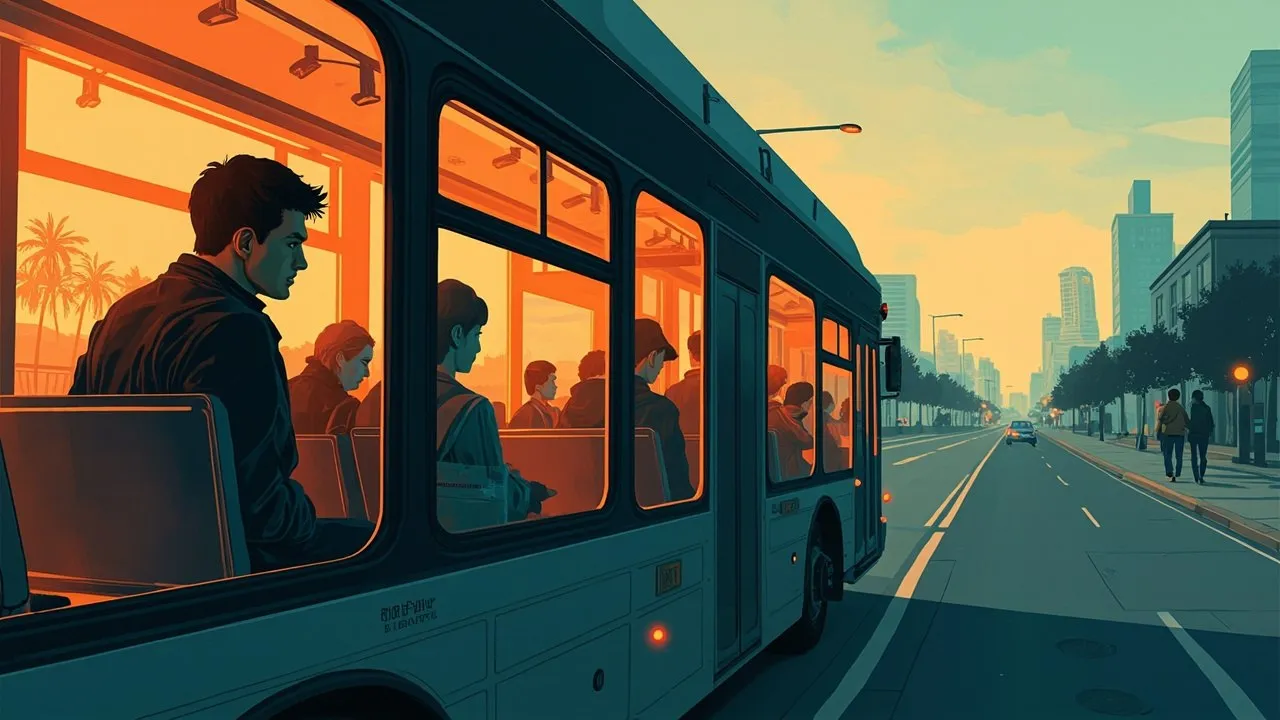
If I had to describe my life with a metaphor, I think I'm a lot like a city bus.
At every stop, someone gets on.
At the next stop, someone gets off.
In elementary school, there was one set of passengers.
In middle school, a different set.
High school, another set.
Beijing, another set.
Qingdao, another set.
And since coming to Japan, I've met a whole new group of people.
Some people rode with me for ten stops.
Some rode with me for a hundred.
Some only stayed for a very short stretch.
I used to think that was just how life worked.
People coming and going — perfectly normal.
But now I've started to think:
If a bus only ever has people getting on and off, and no one ever wants to stay on for the whole ride, then even though it's busy every single day, it might never actually have a true companion on board.
Something I Started Realizing in High School: Where You Stand Matters
There's another thing I began to notice back in high school.
Where a person positions themselves matters enormously.
And "where" doesn't just mean geography.
It also means the school you attend, the industry you work in, the company, the city, and the people you interact with every day.
Why did this become so clear to me after high school specifically?
Because high school is itself a kind of filtering process.
Elementary and middle school are compulsory education — everyone's basically funneled through the same system.
But once you get to high school, differences start to show up clearly: academic ability, family background, interests, goals, and ways of thinking about the future.
So once I started high school, I could feel it plainly:
My high school classmates were already a completely different group of people from my elementary and middle school classmates.
After graduating high school, I went to Beijing.
There, I met a new group of friends.
For the first time, they really made me understand how different people in a big city could be — in the way they thought, the careers they chose, the goals they set — compared to everyone I'd known before.
Then I went to Qingdao.
And now I'm in Japan.
Every time I've changed environments, it seems the people I meet have changed along with it.
So I've come to believe, more and more:
The kind of people you meet depends heavily on who you are, and where you choose to put yourself.
This isn't about people from one city being better than people from another.
It's that your environment determines your "social radius."
Wherever you live day to day, you're more likely to meet the people who live there.
Wherever you work day to day, you're more likely to meet people from that industry.
Whatever you talk about day to day, you're more likely to run into similar topics.
And what the people around you are talking about will slowly shape your own perspective too.
So sometimes we ask ourselves:
"Why aren't there any impressive people around me?"
But maybe the real question should be:
"Is the environment I'm in right now actually capable of bringing me the kind of people I want to meet?"
I Don't Like Bothering Other People
There's another very important reason:
I don't like bothering other people.
If I can do something myself, I do it myself.
If I can solve a problem myself, I solve it myself.
If I can look up information myself, I look it up myself.
Unless it's absolutely necessary, I'm reluctant to ask for help.
Because I don't like owing people.
In my old way of thinking:
Bothering someone = owing them a favor.
And I didn't want to owe anyone anything.
So I always believed that being able to solve problems independently was a strength.
I still think independence matters.
But over time, I've slowly realized something:
Relationships between people seem to actually need a bit of "bothering" each other.
You help me once.
I help you once.
You need me — I show up.
I need you — you're willing to help.
Again and again.
And the relationship deepens through that back-and-forth.
I used to think:
"I don't need you, and you don't need me — isn't that great?"
But now I think the opposite might be true.
"When you need me, you know I'll help. When I need you, I know you'll help."
That process of needing each other, of helping each other — maybe that's exactly where real bonds grow from.
I Like Being Alone
Of course, there's also a very practical reason.
I genuinely enjoy being by myself.
Friends have told me before:
"Don't just sit at home during your free time — go out and hang out with people more."
But being alone has never really bothered me.
Reading alone.
Walking alone.
Going to the library alone.
Studying alone.
Going somewhere unfamiliar alone.
Even just sitting in a park alone, doing nothing.
I can genuinely enjoy all of it.
So compared to people who really need a lot of social interaction, my need for friends has never been that intense.
Eating alone doesn't make me feel lonely.
Not having plans on a weekend doesn't make me feel bored.
This is probably another reason I've never put much effort into maintaining relationships.
Because to me:
Being alone is completely fine.
But after I later met some genuinely high-quality friends, I slowly started to realize:
Living alone can be perfectly good.
But that doesn't mean friendship doesn't matter.
"Alone You Can Move Fast, But Together You Can Go Far"
About two years ago, I heard a saying:
"Alone, you can move fast. Together, you can go far."
At the time, I just thought it sounded reasonable.
But I didn't really understand it back then.
It wasn't until I met friends I genuinely respected and admired that I slowly began to understand the weight of that sentence.
Being alone is, admittedly, freeing.
No waiting for anyone.
No accommodating anyone.
No considering anyone else's schedule.
Go wherever you want, whenever you want.
Leave whenever you feel like it.
For a lot of things, doing them alone is even more efficient.
But one person's capacity is, in the end, limited.
You can't know everything.
You can't have experience in every field.
You can't stay strong at every stage of your life.
Sometimes, you need a friend to tell you:
"Have you considered another possibility?"
Sometimes, you need someone who knows a field better than you do.
Sometimes, you need someone to listen when you're lost.
Sometimes, you don't even need them to solve anything —
just having someone walk part of the way with you is enough.
That's when you realize:
The real value of a friend isn't passing time together.
It's being able to reach places you'd have a hard time reaching alone.
Maybe I Need to Relearn How to "Be a Friend"
So looking back now, I don't think my problem was ever really "not being good at making friends."
It was something else:
I was too used to thinking of "friend" as "someone who lives life alongside me."
If we see each other every day, we're naturally friends.
If we work together, we naturally become close.
If we live in the same city, staying in touch happens naturally.
But the moment distance enters the picture, I don't know what to do.
Real friendship, though, might require a different kind of skill:
The willingness to keep showing up in each other's lives, even when you're not in the same place.
You don't have to talk every day.
You don't have to check in every day.
But when you see something and it makes you think of someone, send it to them.
When you think of a friend out of nowhere, just ask:
"How've you been?"
If you see they're struggling, even if you can't be there in person, you can still say:
"If you need anything, let me know."
These things all seem small.
They might even seem meaningless.
But I've started to think:
Relationships might actually be sustained by exactly these small, seemingly meaningless gestures.
Not Everyone Has to Stay for the Whole Journey
Of course, I've also come to accept something else now:
Not everyone I've ever met needs to stay in touch forever.
Some friends mattered a lot at one point.
But later, because of graduation, work, moving, marriage, or a shift in life direction, we drifted toward different places.
No one wronged anyone.
Nothing went wrong between us.
It's just that two lives started heading in different directions.
I don't think relationships like that need to be forced to continue.
After all, life is basically a bus that keeps driving forward.
People get on.
People get off.
That's normal.
What actually matters is this:
When someone is willing to travel a long way with you, do you recognize how rare that is?
And:
When you consider someone an important friend, have you actually told them so?
I Want to Be a Better Companion on the Road
I still like being alone.
I still don't enjoy meaningless socializing.
I still don't love bothering people.
None of that is probably going to change.
But I've started to understand something:
Being independent and refusing connection are two different things.
A person can live independently.
And still have deep relationships.
You don't need to talk every day.
You don't need to be together all the time.
But you need to be willing to reach out when it actually matters.
I used to think:
"I won't bother people, and I don't want people to bother me."
Now I think:
"Sometimes, being willing to bother someone is actually a form of trust."
And maybe that's exactly how real bonds between friends grow — little by little.
The Bus Keeps Moving Forward
If life really is a bus.
Then I think I've already ridden quite a long way.
Along the way, plenty of people got on.
Plenty of people got off.
Some only stayed for a few stops.
Some rode with me a long way.
And there are some I hope will keep riding with me.
I no longer expect everyone to stay for the entire ride.
That's not realistic.
I just hope that on the road ahead, I get to meet people who are genuinely worth knowing.
And I hope I can learn one more thing:
Don't just wait for someone to get on.
Sometimes, save a seat for someone yourself.
Because I'm finally starting to understand:
Alone, you really can move fast.
But there are places you'll never reach alone.
And the people willing to travel far with you — they're the truly precious companions of a lifetime.