So far, I have had job interviews with three companies.
It’s still a small number, but after going through these interviews, I’ve gradually started to notice some things I hadn’t really thought about before.
One question came up in almost every interview:
“Have you ever worked part-time in Japan?”
My answer has always been:
“No.”
That is simply the truth, so I answer honestly.
I usually explain:
“I wanted to spend as much time as possible studying Japanese, so I didn’t take a part-time job.”
An Answer That Seems to Surprise Interviewers
Whenever I give that answer, the interviewer seems a little surprised.
Perhaps, from their perspective, they have the impression that most international students studying in Japan have some kind of part-time job.
And that would be understandable.
Many international students attend Japanese language school while working part-time at convenience stores, restaurants, supermarkets, and so on.
But my situation was a little different.
I didn't come to Japan simply to study Japanese.
I want to live in Japan for the long term.
If I want to live in Japan for a long time, I believe Japanese is extremely important.
So when I first came to Japan, my thinking was very simple:
I wanted to spend as much of my available time as possible studying Japanese.
There was also another very practical reason.
When I came to Japan, I had already prepared enough money to cover my living expenses.
So I wasn't in a situation where I absolutely needed a part-time job to support myself.
In other words, I had the financial room not to work part-time.
At the time, I thought:
“Instead of spending those hours working, I might as well use all of them to study Japanese.”
But Looking Back, There Was Probably Another Reason
However, looking back now, I think there was probably another reason I didn't work part-time.
To be honest,
I was afraid.
Or, more precisely:
I didn't have enough courage to take that first step.
When I study Japanese, I can sit in a classroom by myself, memorize vocabulary, study grammar, and do practice exercises.
It's certainly difficult, but at least I'm doing it within an environment I'm comfortable with.
Working part-time is different.
You have to enter a real Japanese workplace.
You have to communicate with Japanese people.
You have to understand what they are saying and respond appropriately.
And that's exactly what I was most afraid of at the time.
So perhaps I gave myself a very reasonable-sounding explanation:
“I don't work part-time because I want to spend all my time studying Japanese.”
That reason wasn't wrong.
But looking back now, I think it may also have served as a kind of protection that allowed me to avoid stepping outside my comfort zone.
Not Working Part-Time Has Its Advantages
Of course, I don't think that not having a part-time job was simply a mistake.
Everything has both advantages and disadvantages.
The biggest advantage of not working part-time is that I had more time and energy for studying.
During class, I can clearly feel that I have more energy than some of my classmates who work part-time.
Some students work late into the night and come to school the next day looking exhausted and half-asleep.
Some kind and thoughtful teachers even ask them:
“Were you working last night?”
or:
“How many hours did you sleep?”
The teachers understand that balancing school and a part-time job isn't easy for international students.
If someone is constantly sleep-deprived and exhausted, that can naturally affect their Japanese studies as well.
So from this perspective, focusing entirely on Japanese was definitely beneficial for me.
But I Also Missed Another Kind of Learning Opportunity
At the same time, I've gradually realized the other side of the story.
The students who work part-time are much better than me at listening and speaking.
That's simply a fact I have to admit.
I have some advantages when it comes to kanji and reading.
After all, Chinese and Japanese share a huge number of Chinese characters.
Even when I can't read a Japanese sentence perfectly, I can often guess its general meaning from the kanji.
But in an actual conversation, that advantage isn't nearly as useful.
When someone says something to me, I have to understand it immediately.
Then I have to process the meaning.
And then I have to respond in Japanese.
That's completely different from sitting in a classroom and answering reading comprehension questions.
And this is exactly the kind of training I've been missing.
My Interviews Made Me Realize Something Very Practical
After three interviews, I also noticed something that surprised me.
Interviewers don't seem to care about JLPT certificates as much as I had expected.
Of course, JLPT certificates have value.
But based on my actual interview experiences, what seems to matter more is:
“Can you actually communicate with people in Japanese?”
And besides Japanese ability, they also seem interested in whether you have experience working in Japan.
Why?
I later used AI to look into this question as well.
From an employer's perspective, asking about part-time work may not simply be about whether you have worked part-time.
They may also be trying to understand other things through that experience.
1. Have you actually worked in Japan?
Studying Japanese at school is one thing.
Working in a real Japanese workplace is something completely different.
A part-time job allows an international student to experience Japanese working practices, attitudes toward time, customer service, and workplace communication in a real environment.
2. Can you work with other people?
Work isn't something you do entirely by yourself.
You need to communicate with colleagues, follow instructions from supervisors, and work according to the rules of the team.
So having part-time work experience can, to some extent, demonstrate:
“I've already experienced working with other people in a Japanese workplace.”
3. Can you stick with something over time?
This may also be something employers pay attention to.
When hiring a foreign employee, companies aren't necessarily thinking only about technical ability and Japanese proficiency.
They may also wonder:
“Can this person adapt to a Japanese workplace?”
“Can they stay with the company for the long term?”
From that perspective, having consistently worked a part-time job can provide employers with one useful reference point.
So I've Started Rethinking Part-Time Work
In the past, I thought:
“I came to Japan to study Japanese, so there is no need for me to work part-time.”
But my thinking has changed somewhat.
If my only goal were to pass the JLPT, then spending more time memorizing vocabulary, studying grammar, and doing reading exercises might indeed be more efficient.
But my goal is:
to live and work in Japan for the long term.
If that's the goal, then simply studying Japanese in a classroom may not be enough.
Because real Japanese doesn't exist only in textbooks and exam questions.
It exists:
At a convenience store checkout.
In a restaurant kitchen.
In conversations between coworkers.
In instructions from a supervisor.
On the phone.
And even in those unexpected conversations that you never prepared for.
All of those are Japanese too.
And these are experiences that textbooks can never completely teach you.
I Want to Step Outside During the Autumn Break
Right now, my school is on autumn break.
I have about half a month of free time.
So I've started thinking:
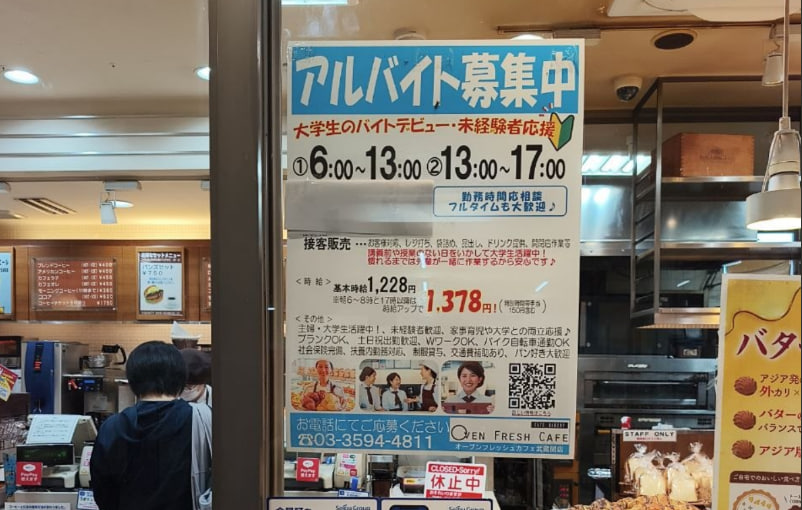
Maybe I should find a part-time job.
This time, my main goal isn't to make money.
I don't have a major financial need to work right now.
Instead, I want to use these two weeks or so to actually enter a Japanese working environment.
Improve my listening.
Improve my speaking.
Learn how Japanese people work.
Experience how people communicate and interact with each other in the workplace.
And most importantly:
force myself out of my comfort zone.
For a long time, I thought:
“My Japanese isn't good enough yet, so I'm afraid to talk to Japanese people.”
But now I think that if I keep waiting until my Japanese is “good enough” before I start communicating, I may never truly improve.
Language is something you develop by actually using it in real situations.
You don't start speaking because you've already mastered the language. You become better at speaking because you keep speaking.
This time, I want to try a different approach.
Step outside first.
Try first.
It's okay if I can't understand everything at the beginning.
It's okay if I make mistakes.
It's okay if someone points out my mistakes.
That's all part of the process.
Because what I really need now may no longer be another Japanese certificate with a higher score.
What I need is:
more opportunities to actually use Japanese.
And perhaps that is one of the things I still need in order to find a job and build a life in Japan.